

TM 1-1500-204-23-11
iber properties (for binding the fabric together) and
quality stitched fabrics can be relatively high com-
cost. The stitching process allows a variety of iber
pared to wovens. Heavyweight fabrics, while enabling
orientations, beyond the simple 0/90 degrees of woven
large quantities of iber to be incorporated rapidly into
fabrics, to be combined into one fabric. Multiaxial
the component, can also be dificult to impregnate
fabrics have the following main characteristics:
with resin without some automated process. Finally,
the stitching process, unless carefully controlled, can
bunch together the ibers, particularly in the 0 degree
(1) Advantages. The two key improvements
direction, creating resin rich areas in the laminate.
with stitched multiaxial fabrics over woven types are
better mechanical properties and improved compo-
(3) Stitched Fabric Construction. The most
nent build speed. Better mechanical properties result
from the fact that the ibers are always straight and
common forms of this type of fabric are weave and
noncrimped, and that more orientations of iber are
stitch, and simultaneous stitch.
available from the increased number of layers of fab-
ric. Component build speed is improved because the
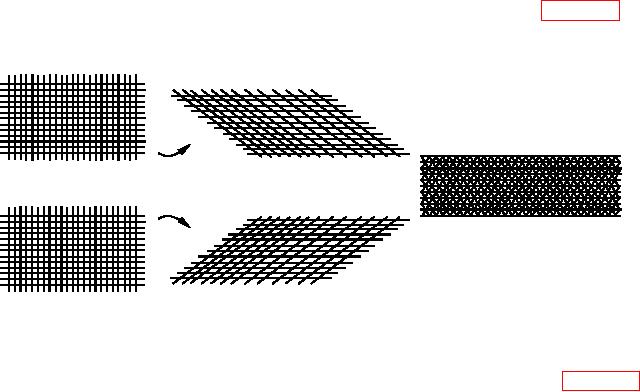
(a) Weave and Stitch. With the Weave and
fabrics can be made thicker and with multiple iber
Stitch method, the +45 and -45 degree layers can be
orientations so fewer layers need to be included in
made by weaving ill unidirectionals and then skewing
the laminate sequence.
the fabric to 45 degrees. A warp unidirectional or a
ill unidirectional can also be used unskewed to make
(2) Disadvantages. Polyester stitching iber
a 0 and 90 degree layer. If both 0 and 90 degree
does not bond well to some resin systems, so the
layers are present in a multilayer stitched fabric, this
stitching can be a starting point for wicking or other
can be provided by a conventional 0/90 degree woven
failure initiation. The fabric production process can
fabric. Because heavy rovings can be used to make
also be slow and the cost of the machinery high. This,
each layer, the weaving process is relatively fast, as
together with the fact that more expensive, small, iber
is the subsequent stitching together of the layers via
bundles are required to get good surface coverage
a simple stitching frame. See igure 4-11.
for the low weight fabrics, means the cost of good
Figure 4-11. Weave and Stitch Process
(b) Simultaneous Stitch. Simultaneous sti-
then stitched together, as shown in igure 4-12. Unlike
tch manufacture is based on the knitting process.
the weave and stitch method, each layer is unidirec-
Fibers are drawn simultaneously along each axis/layer
tional rather than woven.
until the required layers have been assembled, and