

TM 1-1500-204-23-11
Qualitative Comparison of Fabrics
Property
Plain
Twill
Satin
Basket
Leno
Mock Leno
Good Stability
****
***
**
**
*****
***
Good Drape
**
****
*****
***
*
**
Low Porosity
***
****
*****
**
*
***
Smoothness
**
***
*****
**
*
**
Balance
****
****
**
****
**
****
Symmetrical
*****
***
*
***
*
****
Low-crimp
**
***
*****
**
**/*****
**
***** = excellent, **** = good, *** = acceptable, ** = poor, * = very poor
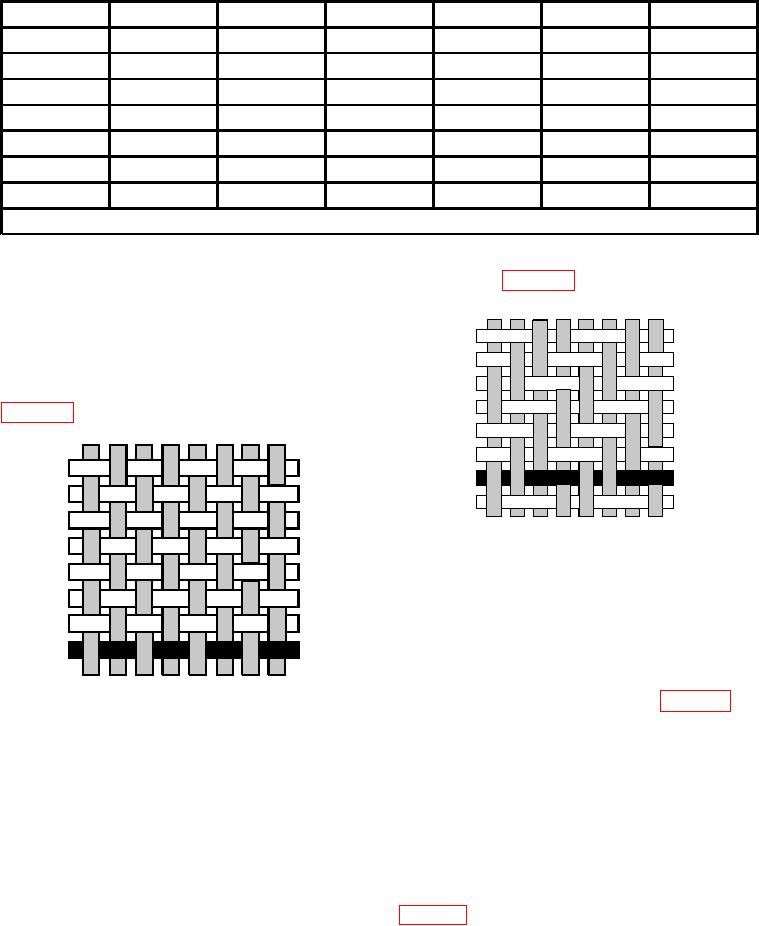
(1) Plain Weave. Each warp yarn passes alter-
the pattern repeats. A 4 X 4 Twill weave is also
nately under and over each ill yarn. The fabric is
available. See igure 4-7.
symmetrical, with good stability and reasonable poros-
ity. Plain weave is the most dificult to drape, and the
high level of iber crimp imparts relatively low mechan-
ical properties compared with the other weave styles.
With large iber bundles, this weave style gives exces-
sive crimp and, therefore, it is not usually used for
heavy fabrics (over 24 ounces per square yard). See
Figure 4-7. Twill Weave (2X2 Twill Shown)
(3) Harness Satin Weave. Harness
Satin
weaves were irst produced in China over a thou-
sand years ago. The weave style was designed to
enhance the appearance of silk making it appear to
shimmer in the light. This is accomplished by limiting
the interlacing of warp and ill yarns to a fraction
of that seen in plain weave fabrics. For example, if
we follow a warp yarn (horizontal) in igure 4-8, we
Figure 4-6. Plain Weave
see that it interlaces (goes under) only one ill yarn
every three it goes over. Three plus one equals four,
(2) Twill Weave. One warp yarn is alternately
thus this weave style is known as a four-harness
woven over and under two ill yarns in a regular
satin weave. Weaving a fabric in this way creates
repeated manner offsetting the over and under pattern
a material on which we see three-times as much of
by a single yarn with each pass. This produces a
the warp yarns on one side of the fabric as we do
distinctive visual effect of a broken diagonal rib in the
on the other. This is referred to as the "warp face"
fabric. Superior drape properties are seen in the twill
of the fabric. Conversely, on the other side of the
weave over the plain weave with only a small reduction
fabric we see three times as much of the ill yarns
in stability. With reduced crimp, the fabric also has
traveling at 90 degrees to their counterparts. Harness
a smoother surface and slightly higher mechanical
satins typically available for use in composites are
properties. Twill is classiied by the number of ill
four-harness, ive-harness, and eight-harness satins
yarns crossed under and over by the warp iber before
(igure 4-8 ).